
Free Tool
Reference gene finder - geNorm
Find the most stable reference genes for your qPCR experiment.
Import your Cq values, know which genes to trust in less than 30 seconds
- Built on the original geNorm algorithm
- Publication-ready PDF report
- Free, no install, runs in your browser
How Clarida implements it
- Faithful to the original 2002 algorithm - same validated methodology, same M-values
- Ranks all candidates down to the single most stable gene - the original algorithm could only identify the best pair. This improvement was first introduced in qbase+.
- Calculates the pairwise variation (V-value) to determine the optimal number of reference genes
- Runs in the browser - no installation, free, with results in seconds and no account needed
The method you trust, without the friction
The science is exactly the geNorm you cite - the 2002 algorithm, unchanged. What is different is everything around it: import or paste your Cq values and get a ranked result with a clear recommendation in seconds, in your browser, with no installation, no spreadsheet macros, and none of the friction of a desktop tool.
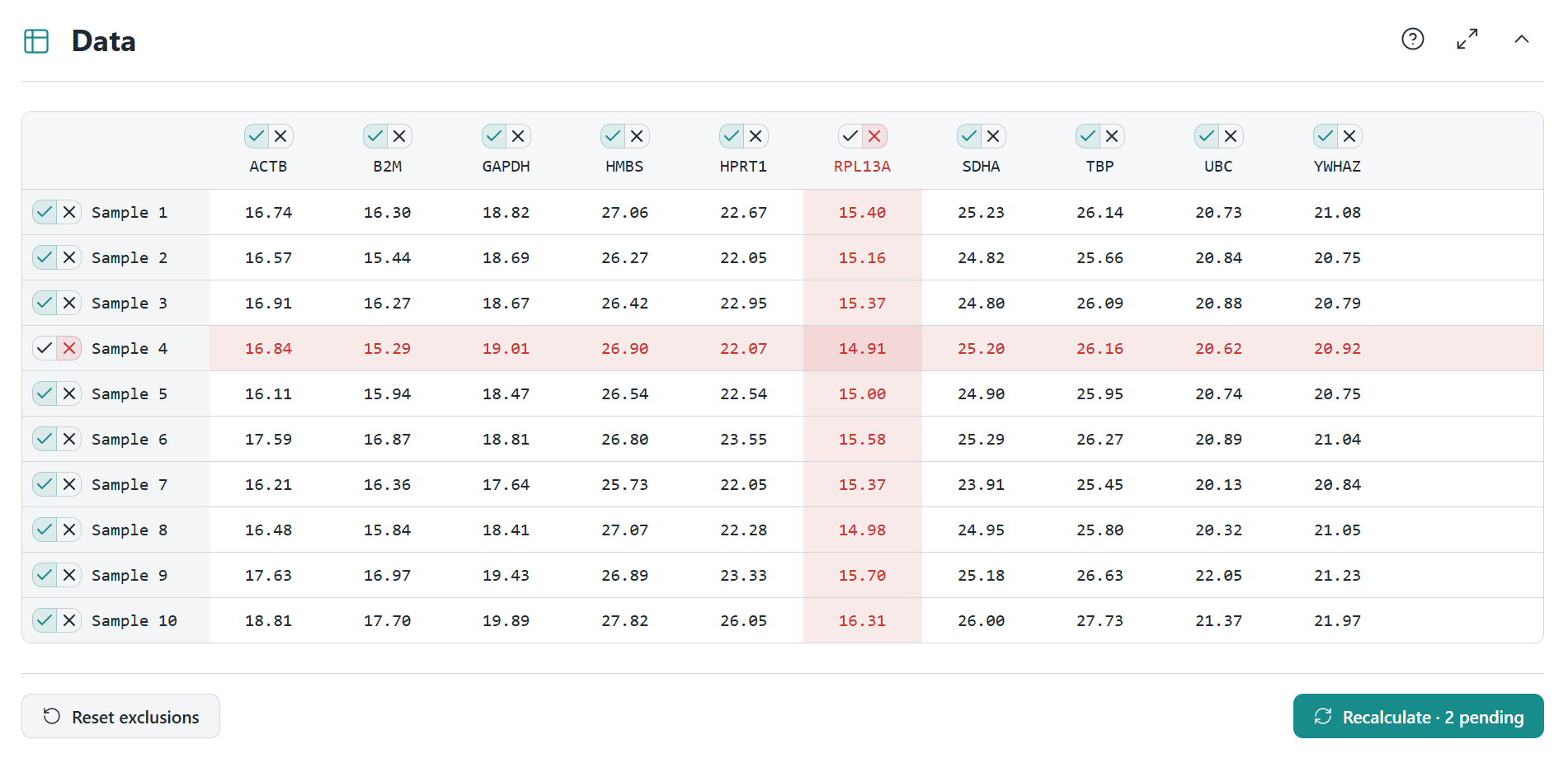
A failed well, a degraded sample, or a contaminated assay should not skew your stability ranking. Switch any sample or assay off directly in the grid, recalculate, and the M-value ranking updates - then switch it back on to compare. The data you imported or pasted stays exactly as you entered it: no deleting rows or columns, no re-importing a trimmed matrix every time you want to test a different subset.
- Toggle genes or samples in or out and watch the ranking recalculate live
- A plain-language recommendation of which genes to use and how many
- Email yourself a publication-ready PDF - stability ranking, V-value plot, and a MIQE-compliant methods paragraph for your manuscript (see an example report)
- Create a free account to save your analysis and revisit it any time
- Part of the full Clarida qPCR platform - reference gene selection flows straight into QC, inter-run calibration, statistics, and citable saved analyses
Origin
geNorm was developed by Jo Vandesompele and colleagues at Ghent University, published in Genome Biology in 2002 (Vandesompele et al., 2002). With over 23,000 citations, it is the most widely adopted algorithm for reference gene selection in qPCR experiments. The paper was initially rejected by traditional journals as "too specialized" before becoming one of the most-cited methods papers in molecular biology.
The algorithm calculates an M-value - an expression stability measure - for each candidate reference gene by comparing pairwise expression ratios across your samples. Genes with the lowest M-value are the most stable across your experimental conditions. The stepwise exclusion of the least stable gene allows you to rank all candidates. The algorithm also calculates pairwise variation (V-value) to determine the optimal number of reference genes for your normalization.
Jo Vandesompele is a scientific advisor at Clarida.
Frequently asked questions
Roadmap
- PlannedIntelligent handling of missing data - retain as many data points as possible
- PlannedGlobal mean normalization for large unbiased gene sets
- PlannedAPI and MCP server - run geNorm from your own tools, scripts, or AI assistants
- PlannedAdditional algorithm (NormFinder) for cross-validation
- PlannedAnalyze multiple experiments at once - run reference gene selection at scale
Are your reference genes reliable?
Find out free, in less than 30 seconds.