
FOR ACADEMIC LABS
qPCR results that survive peer review.
A complete qPCR workflow, from framing the run to a figure you can defend, built by the team behind qbase+, geNorm and MIQE, on the standards reviewers reach for.
The daily qPCR grind
The overhead tax on every result.
You pick the same reference genes your colleague did, and have no validation on file when a reviewer asks.
Plate layouts, flagged wells & samples live in your head or a disconnected tool, so the next step starts from a gap.
You re-enter Cq values into a normalization sheet and a stats tool, where one misplaced paste changes the result.
An afternoon lost to reformatting the figure to match last month’s, and later you can’t trace it back to the analysis.
Not anymore. Clarida runs it end to end, and it’s easy.
Start from a template or saved design, so runs are consistent and comparable from the first plate.
geNorm reference-gene validation built in, so you report the way reviewers expect.
Build the record as you go, in place, so every decision downstream has the full context.
Raw data or Cq values in, MIQE-aligned results out, with the method recorded instead of re-derived each time.
Every step is traceable. Reopen the exact analysis to answer a reviewer, or invite a colleague in to check it.
The D-DEAR method
From question to figure, in one place.
One continuous workflow, where every step feeds the next, so the reasoning behind each number is retained and the result you publish is one you can defend.
That’s D-DEAR: Define, Design, Execute, Analyze, Report. Everything except the cycler.
This is where the experiment gets its context, before any plate or pipetting: a clear goal, the background behind it, and the papers that justify your choices, with your ELN file attached or a Clarida template to start from.
Because it lives with the experiment instead of in a separate document, the reasoning travels with everything downstream, from the plate you design to the final figure.
So months later, when a reviewer asks why you set it up this way, the answer is on the record instead of reconstructed from memory.
This is where the decisions a reviewer will interrogate get made and written down: which targets and reference genes go in, your biological and technical replicate structure, and your controls, the NTC and the no-RT for RT-qPCR. They are your calls; Clarida keeps them together and on the record.
From your samples and assays, Clarida generates the plate layout and applies sensible defaults you can override, so you are not hand-placing wells, and you take full manual control whenever the science needs a specific arrangement.
Because the layout is deliberate and recorded, well positions and controls stay visible and traceable into analysis, instead of becoming an undocumented source of variation. It is also the last point before the bench where catching a problem costs you nothing.
A materials checklist, your mixes at the calculated volumes, and a guided plate fill you follow at the bench, then you start the run on your own instrument. Clarida guides and records here, it does not pipette or drive the cycler.
As you load, you can note anything you see on a specific well, a bubble, a short pipette, a cloudy reagent, and that note stays attached to the well.
So later, in analysis, that note sits right next to the measurement: you can tell a bench artifact from real biology, and an exclusion you make is one you can explain rather than reconstruct. The call stays yours; the context arrives with it.
Bring raw amplification curves and Clarida can call Cq itself, with more than one established method to choose from, so the chain is transparent from the fluorescence up.
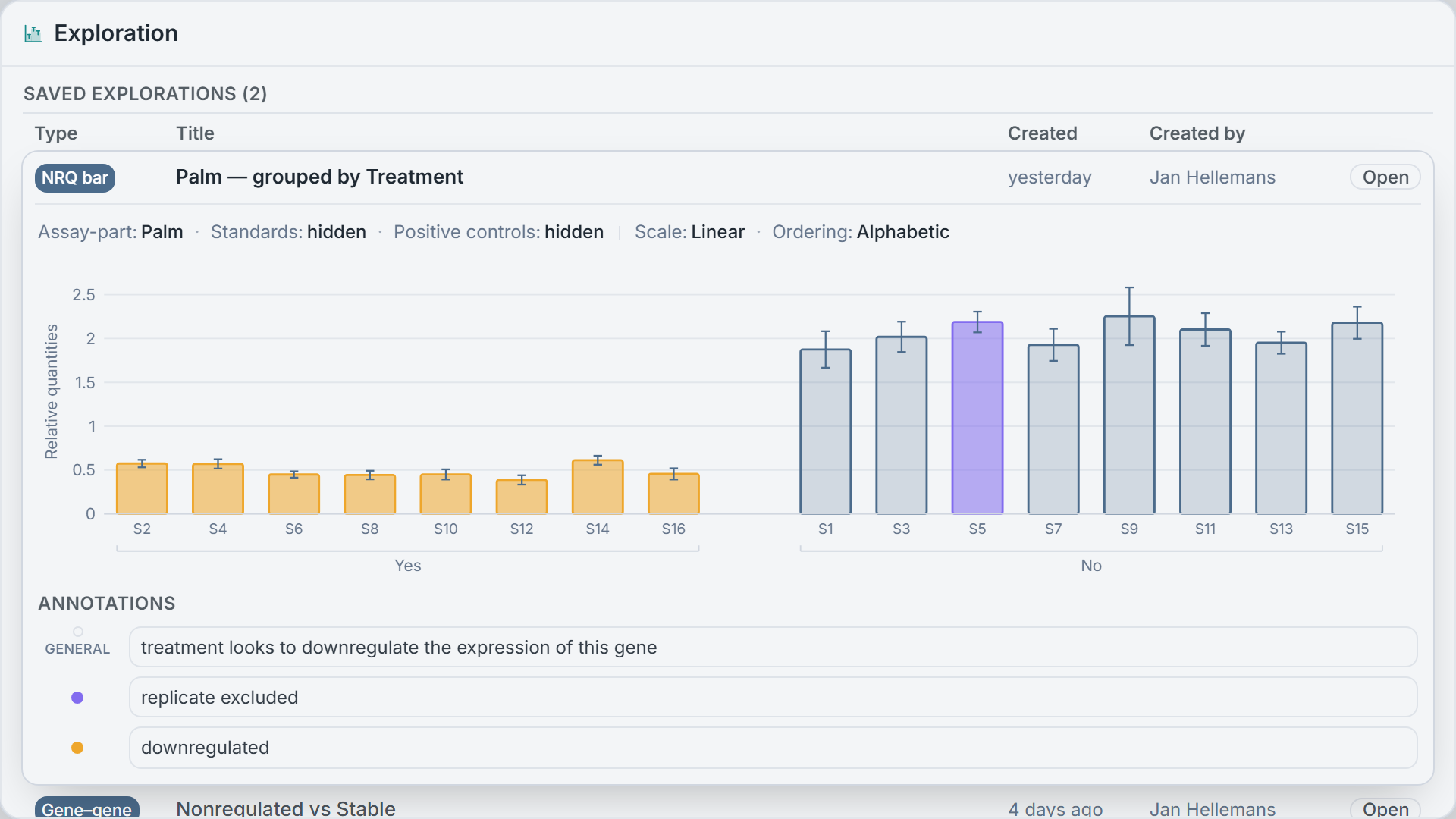
From there the whole workflow is yours: Cq processing, reference-gene normalization scored on geNorm or a global mean, efficiency-corrected quantification, per-metric QC that surfaces outliers without dropping them for you, exploration to follow a hunch, and the statistics qPCR papers actually need, returning an effect with a confidence interval rather than a lone p-value.
Your imported Cq is never overwritten, and every step stays on the record, so the path from raw signal to published figure is one you can show.
When a reviewer asks how you got a number, you reopen the exact analysis and the answer is there: the method, the settings and the data behind every value, already on the record instead of reconstructed from memory.
The methods and settings are captured the way MIQE asks you to report them, so your methods section is complete and every result traces back to how it was produced. Where an interpretation is AI-written, it is labelled as such and kept separate from the computed numbers.
The report carries its own data inside it, which is why the answer still works months later: it opens and re-analyses without Clarida, a database, or the software that made it.
You choose what goes in, add your conclusion, and save it as a versioned record you can reopen, re-download, and hand to a colleague or attach to your paper. So the whole experiment, from the question you framed to the figure you publish, travels in one record you can defend.
Why switch
One workflow, not a stack of disconnected tools.
Right now a result is a relay: a notebook to frame it, Excel to plan the plate, the cycler’s analysis software for Cq values, qbase+ or another reference-gene tool to normalize, and GraphPad Prism for the figure. Every handoff is a chance to drop the baton. Clarida is one workflow in place of all of them, qbase+ included, since we built it.
New software only earns a switch when it is better, faster and easier than the tools you already know, and that is the bar we set for it.
Today
Exported, reformatted, and pasted between apps that never talk.
With Clarida
- Definegoal & context
- Designsamples, assays, plate & protocol
- Executeguided benchwork & notes
- AnalyzeCq, normalization & stats
- Reportone traceable record
One record, from the question you framed to the figure you publish.
Survive the methods review
geNorm normalization and efficiency correction, from the people who wrote them.
Change one thing, not everything
Correct an annotation, exclude a well or change a setting, and every result downstream updates on its own. No redoing six spreadsheets by hand.
Answer today, no setup
Free, in your browser. No install, no IT ticket, just your own data and a real result.
From the source
Trust the analysis, because they wrote it.
Clarida comes from the team behind geNorm, qbase+ and the MIQE guidelines the field reports to. The methods you rely on stay in the hands that defined them, now maintained and moved to the cloud.
28,000+
citations of the geNorm and qBase methods
Since 2007
building qPCR analysis software
MIQE
the reporting standard, co-authored by the team
For the lab
Reproducibility that outlives the people
Holds up in review
Every result is validated and traceable, so the methods are defensible when a reviewer asks how you got them.
Nothing leaves with the student
The analysis lives in the workspace, not a departing student's laptop. The recipe stays with the lab.
One method, every bench
Everyone analyses the same validated way, so results compare cleanly across people, projects and years.
Free to start, academic pricing
Anyone can start on the free tier today. The lab formalises it later, at academic pricing, when it is ready.
Feedback before you commit
Invite your PI or a labmate into the exact analysis to weigh in, before it goes in a paper or a thesis chapter. Shared workspaces come with the paid tiers.
Ready to take it further?
See the whole workflow, from experiment design to a defensible figure. Bring your PI along.
Book a walkthroughQuestions, answered
Yes. There is a free tier with no credit card, and you can analyze your own data today. The scientific rigor is not paywalled: geNorm reference-gene validation, efficiency correction and MIQE-aligned reporting are all on the free tier.
Paid tiers add capacity and shared workspaces for collaboration, not the basic rigor. You upgrade when your lab outgrows the free tier, not to unlock a defensible result.
No. The free tier runs in your browser with nothing to install and no license to provision, so you can start on your own data without waiting on anyone.
Your PI comes in later, at the point where the lab wants more capacity or shared workspaces. Until then, you are the one who decides to try it.
No. Bring the data you already have, raw amplification data or the Cq values your instrument produced, and pick up from there.
If you have qbase+ experiments, those import too, so you are not restarting from zero.
Clarida is instrument-agnostic and reads qPCR and RT-qPCR data from the major platforms. Start from the Cq values your instrument called, or bring the raw amplification curves and let Clarida call Cq itself, using single-threshold, SDM or LinRegPCR.
Your imported Cq is never overwritten, and you choose which lineage feeds your results.
Reference-gene stability is scored with geNorm so you can drop an unstable gene, or you can use global-mean normalization. Quantification is efficiency-corrected, and group results come back as a geometric-mean fold-change with confidence intervals, with Benjamini-Hochberg across genes.
The tests are the ones qPCR papers use: t-tests, Wilcoxon, Mann-Whitney, one-way ANOVA and Pearson or Spearman correlation.
Yes. Every step is recorded, so you can reopen the exact analysis months later, and the report carries its own data and methods inside it.
That means a reviewer, or you in six months, can open it and re-analyse without Clarida. Nothing is a black box.
Yes. Your data is yours and you can export it at any time, and because the report is self-contained it opens and re-analyses without Clarida, so there is no lock-in.
When you move on, the analysis stays in the workspace and reopens exactly as you left it, rather than leaving on a laptop. To work with a colleague, you invite them into the workspace on a paid tier, not by sharing a public link.
Your data is encrypted in transit and at rest, and hosted in the EU. It stays private to your workspace and is yours to export at any time.
Unpublished results stay unpublished: your work is visible only inside your workspace, and reaches a colleague outside it only when you invite them in.
Your next result, one you can defend.
Free to start, no credit card, and your data exports anytime.